Falling Through the Ice

I’ve been trying to figure out how to describe what the last two days have felt like. As I was putting things away, it finally came to me.

For me, going through life is like walking on a frozen lake. There are times when the ice is thick and solid, and I can walk with confidence. Then that step comes and you hear the crack. Sometimes it’s so soft it’s barely noticeable and it creates the smallest of lines. Other times it is thunderously loud and the break in the ice comes quickly and forcefully.

Over the years, there have been times that the ice breaks enough that my foot goes through and into the icy water. There have been times where I’m able to step over the crack and find my way back to solid ice with reasonable ease. Sometimes, the crack is so small I forget about it with the next step.

Yesterday felt like the ice under my feet simply disappeared and I was plunged into the freezing water.

Dr. Brené Brown, a research professor at the University of Houston, has an amazing video in which she illustrates the difference between empathy and sympathy. (If you haven’t seen it, you can watch it here.) In it, she describes how many times people who are showing sympathy draw a nice silver line around another person’s problem or emotion. I think people try to put the silver lining around a person’s problems and emotions for a variety of reasons: they want to “fix” it; they are uncomfortable with the strong emotion of the other person; they don’t understand the intensity of the level of the feeling for the person; or maybe for them, the same situation wouldn’t result in the same feelings or response and so they don’t understand why it’s happening for this other person.

I think that some people accept silver linings because it’s easier than to stay with the current feeling. Or maybe the person having the strong, hard feeling can tell that the other person is uncomfortable with how she’s feeling and wants to help that person feel better. Or maybe it’s because he’s just not ready to deal with the situation or feeling. And sometimes the silver lining puts things in a different perspective for the person and she is ready and able to move on.

I can be a master silver-liner. In most situations, I can find the bright side and do my best to convince the other person to see the pretty silver light. In fact, I do it to myself all the time.

Worn out after a hard day at work? At least I have a job.

Frustrated at the sight of a dirty house that was literally clean five minutes ago? At least I have a house.

Another medical bill in the mail? At least you are able to access healthcare.

Tired of listening to Josie get anxious when she doesn’t have her note saying that I’m going to pick her up at the same time as I always do? At least she is using her words to express her feelings.

Annoyed at the extra time it takes to put Moses’ socks, braces, and shoes on? At least he can walk.

For any hard situation I may be going through, there is always someone who seems to be going through something harder. But does that mean that my situation magically ceases to be hard? Does it become less important?

Many times, it seems that the answer is “yes”. Get over yourself and your “hardship” and be grateful for what you have. Or at least leave it at the door when you leave your home.

Like in Dr. Brown’s video, I feel like the ice I was standing on – ice that I thought was solid – wasn’t so solid after all. As I kept marching forward on my path, my foot hit a weak spot and I fell through. When I hit the water, many of those hard situations and feelings that I thought I had perfectly silver lined were there waiting for me. I’m pretty sure they are what weakened the ice below me in the first place.

I have been silver lining things in my relationships.

I have been silver lining things in my family.

I have been silver lining things in my job.

I have been silver lining things about myself.

Instead of allowing myself to feel the sadness, disappointment, frustration, annoyance, irritation, hurt, etc., I’ve silver lined it, pushed it down, and went on my way. Sometimes the silver lining works, sometimes it doesn’t. When it doesn’t, that feeling lies dormant until the ice cracks and allows it to come to the surface once more.

I took another mental health day today. I felt better than I did yesterday, but I knew that I wasn’t on solid ice just yet. As I was cleaning off my dresser this afternoon, I finally pulled out a bag that has been hiding underneath it for a little over three years.

It’s a bag that I received from the Down Syndrome Association of Greater St. Louis shortly after Moses was born. In it were resources that gave information about Down syndrome, tips for raising a child with Down syndrome, brochures for agencies that provide assistance for kids with Down syndrome, and a couple of books about having a child with Down syndrome.

As I went through the contents, I broke down. Much like I did when I looked at Moses’ first goal report for his IEP.

For three years, I’ve worked really hard at drawing that silver line around the challenges that come with a child with Down syndrome.

He has Down syndrome? At least he’s healthy.

He spent 6 days on a ventilator because of RSV? At least it wasn’t 7 days of watching a machine keep him alive.

He has an ASD in his heart? At least it was able to be repaired by a cardiac catheterization instead of open heart surgery.

He can only recognize and match 10 pictures? At least it’s more than none.

I am fully aware that Moses is doing more physically and cognitively than a lot of other three-year-old kids with Down syndrome. But it’s still hard to see his limitations, especially when it’s in black and white.

As I read through his goals, I was disappointed. I tried to silver line my disappointment with At least he’s making progress.

This place where I’m at is nobody’s fault and it’s not because of one certain thing. It’s a culmination of silver lining my feelings and situations, not taking care of myself consistently, and trying to keep up my facade of strength.

I don’t think that humans were designed to be dismissive of their situations or feelings. I don’t think that humans were designed to be physically or mentally strong all of the time. I think that we were designed to experience life, feel the feelings, rest when we feel weak, and hold others up when we feel strong. And when we find ourselves in that icy water, we can be at peace knowing that God doesn’t want us to stay there and He will help us find our way back to the solid ice.

Changing the Lens of Down Syndrome

A while back, I wrote about a conversation I had with a woman wherein she told me that her daughter was not likely to have a baby of her own because of her age and the higher probability of the baby having Down syndrome. (You can read it here.)

This past summer, I ran into a woman that I had known growing up but hadn’t seen in years. She and I were catching up when she told me that her daughter had one child and was thinking about having another one. The woman said that she hoped her daughter would just be happy and thankful for the one she had because there had been a “genetic scare” and they got lucky the baby was born “normal”.

As with the other conversation, my mind was racing as I tried to listen respectfully while trying to figure out how I was going to enlighten this woman. My chance came when she asked if I had any kids of my own, and I told her that yes, I had two children, Josie and Moses. For some reason, I didn’t come out right then and tell her that Moses had Down syndrome. That didn’t come up until she asked about their ages and school.

I explained to her that we had decided to wait another year before sending Josie to kindergarten because of her late birthday and that Moses would be starting the early childhood program, too, when he turned three in October. That was when I told her that he had Down syndrome and would be going through the evaluation process to have an IEP developed to make sure he was getting what he needed at school.

To be honest, there was a part of me that got a teensy bit of satisfaction from seeing her reaction and scrolling back to her earlier comments to make sure she hadn’t said anything outright offensive. But what really brought me joy was getting to tell her about how amazing Moses is and what a beautiful relationship he has with his big sister. To get to tell her with 100% honesty that I wouldn’t change Moses having Down syndrome for anything because he has brought so much happiness and richer insight to our lives.

A couple of months ago, I was talking with another older-ish woman about a close friend of mine who won a state-level award the same week that she gave birth to her beautiful daughter who has Down syndrome. I watched as her the look on the woman’s face transformed from one of sadness to pure confusion when I went on to say that my reaction was, “How amazing is that?! She hit the lottery! She was named Missouri School Counselor of the Year AND her daughter was born AND she has Down syndrome!” I would say it’s safe to bet that she thought I was saying that to be nice. But I truly wasn’t. I was honestly so incredibly excited for my friend because of her good fortune on all accounts.

Even though it’s the year 2020 and we have amazingly advanced technology and an abundance of information at our fingertips, it is apparent to me that when it comes Down syndrome and other disabilities, it can sometimes seem like we’re still in the Dark Ages. Down syndrome is still viewed through a very negative lens. I know we’ve come along way from the viewpoint that Dr. Benjamin Spock held and published in his best-selling book Baby and Childcare where he recommended that babies born with Down syndrome should be immediately institutionalized because “If [the infant] merely exists at a level that is hardly human, it is much better for the other children and the parents to have him cared for elsewhere.” (Globaldownsyndrome.org) That suggestion was held as true until research was published in 1979 that showed that the IQ of children with Down syndrome that were raised at home both with and without specific attention to stimulation was higher than children with Down syndrome that were raised in an institution.

Nevertheless, we’re still facing a generation of mothers encouraging their daughters NOT to have a baby out of fear it will have Down syndrome. There are still doctors who recommend aborting a baby that has Down syndrome as if they have a crystal ball and somehow know the deficiencies and limitations the child might have will overshadow and negate the child’s strengths and abilities.

Anyone can be a part of helping others change their views and see the beauty and value in the life of a person with Down syndrome. Be excited for a woman who gives birth to a baby that has Down syndrome. Share in a family’s excitement when its child with Down syndrome reaches another milestone. See the beauty in the perseverance and strength of a person with Down syndrome working to overcome one of life’s challenges.

Let’s work together to change the view of Down syndrome from a lens of doom and gloom to one of celebration and possibilities.

Letting Go of the Guilt

The first time I felt it was after getting the results of the fetal echo at St. Louis Children’s Hospital about 2 1/2 months before Moses was born. Hearing that his heart looked perfect sent a huge rush of relief through my mind and body, but instead of walking out of the hospital feeling light as 7-month-pregnant feather, I felt the heavy weight of guilt. 

You see, as Tyson and I walked through Children’s and saw kids with various forms of illnesses and severe disabilities on the way to get the echocardiogram of our baby’s heart, I was prepared to join their club. Even though the ultrasounds up to that point indicated the baby with Down syndrome I was carrying was healthy, I was sure that the other shoe would finally drop and we would find out that we were in for a rough time in the form of an unhealthy heart. 

As happy as I truly was to know my baby’s heart looked healthy, I couldn’t help but to feel incredibly guilty that we were getting off easy. 

Over the past three years, I’ve had that “my son with Down syndrome is very healthy” guilt quite a bit. Yes, we’ve had health issues with him: the scary RSV at 3 months; a heart catheterization procedure at 1 year; two sets of ear tubes; slightly elevated TSH (thyroid) levels. But on days like today when the only “bad” news we get from the doctors is that his TSH level is still slightly elevated and that he’s slightly far- or near-sighted (I can’t remember which!) and has a slight astigmatism in his right eye that will be rechecked at his ophthalmology visit next year, I feel guilty. 

He is healthy. Period. 

While we were at Children’s today finding out that Moses is pretty much the picture of health, I once again saw children with various disabilities and illnesses. I met a couple who’s 1-year-old son with Down syndrome had heart surgery several months ago, coded about 8 hours post-surgery, and are now “back at square one” with his heart and he is still on a feeding tube. I saw another little girl with Down syndrome who was in a modified stroller that could hold her oxygen tubes. I watched as her mother did something to the tube that was connected to her trachea. I saw a couple of kids with Down syndrome with glasses. I saw another boy with Down syndrome who was wearing a mask so as not to either spread germs or contract them or both. 

That’s not even mentioning all the other kids without Down syndrome that had different disabilities and health conditions that I saw as we went from doctor to doctor. Then there’s the infants in the NICU, and the kids in the PICU. The children in the Heart Center and the ones that are there being treated for cancer and other illnesses.

Since we left the hospital today, I’ve once again been experiencing that heavy weight of guilt of having a healthy child where so many others are not. As silly as it might sound, I’ve been asking God “Why?”. 

“Why does my son get to be so healthy?”

“Why does my son get to be so strong?”

“Why does my son get to be so cute?” (Obviously the answer to that is genetics, right?)

And then I had to stop myself from asking “Why?”. I had to give myself permission to let go of the guilt and just be thankful. Feeling guilty isn’t going to do Moses, those other kids, or even myself any good. Instead I should be telling God “Thank you.” 

“Thank you for letting my son be so healthy.”

“Thank you for letting my son be so strong.”

“Thank you for letting my son look so much like me and be so doggone cute.” 

I don’t know what God’s plan is for Moses. I don’t know what God’s plan is for those other kids. I just have to remember to trust that He’s in control. 

Remember to trust that His plan is always right. 

Remember to tell Him “Thank you.” 

Extra Chromosome = Extra Awesome. It’s That Simple.

Josie was a fresh-faced little two-year-old when Moses was born. With her, my focus was more on helping her adjust to having a new baby invading her space than explaining that her new baby brother had Down syndrome. At that point in her young life, telling her that would’ve meant absolutely nothing to her anyway. Still, part of me wondered when the time would come to explain it to her.

While we didn’t explicitly tell her that he had Down syndrome, we didn’t hide it from her, either. When she asked why people were coming to see him, we explained that they were there to help him get stronger and learn how to do things. That explanation was good enough for her, and she quickly began to interject herself into his physical and speech therapy sessions. In fact, there are still times that I have to remind her that the therapists are coming to see Moses, not her.

My question of when I would have to explain what Down syndrome was and that Moses had it was answered this past spring. Josie had found a medal from the Step Up for Down Syndrome Walk we did in St. Louis the previous spring. She had been wearing it around the house for a while when she came to where I was sitting on the couch and asked me to read what it said. I told her it read “Step Up for Down Syndrome”. She looked at the medal again and said, “I don’t cheer for Down syndrome.”

“Oh, yes you do, sister.” was my immediate reply. Of course, her next question was promptly, “Why?”

Taking a deep breath, I said, “Because Moses has Down syndrome. We cheer for him all the time, right?” (As a matter of fact, we cheer for him so much that when he has even the smallest of accomplishments, he looks at whoever is around to make sure they’re properly cheering for him.)

Here came the hard part. Not because I thought that it would somehow change how she looked at him or felt about him, but because explaining the science and complexity of Down syndrome is hard. Explaining it to an adult who has at least heard of a chromosome is hard enough. Explaining it to a 4-year-old is downright difficult.

I did my best to break it down so she could maybe understand part of it. I told her how we all have chromosomes in our bodies and that most people have two of each chromosome in our cells, but Moses and others with Down syndrome have an extra chromosome that changes some of the things in their bodies and makes it harder for them to do somethings. Thankfully, I could tell that she was losing interest and that she was ready to go about her business, so that extremely over-simplified explanation was all she needed.

After that, Josie didn’t ask any more questions or say anything else about Down syndrome.

Until last week.

While I was getting Moses ready for bed one evening, Josie came in his room and asked, “Why doesn’t Moses talk yet?”

“Well,” I started, “It’s because he has Down syndrome and that makes it harder for him to learn how to talk.”

“Oh. Will you tell me about Down syndrome and those chromo-somes again?”

Impressed that she had apparently really been listening to me when I had tried to explain it the first time, I reminded her that most people get two of each chromosome but Moses got extra of one of them which makes it harder for him to do some things, like learn how to talk. This time I added, “But it’s also part of what makes him awesome.”

Without missing a beat, that smart-mouth came back with, “But you don’t have an extra one so you’re not awesome.”

I swear it was all I could do not to come back with, “Well, little girl, neither do you, so what’s that say about you, too?” Instead, I returned the playful smirk she was giving me and told her to go get ready for bed.

What I love most about telling Josie and other kids about Down syndrome and what it means for Moses is their reaction. It’s almost like a healthy indifference. Having that information doesn’t make or break anything in terms of how they feel about him. There’s no looks of pity towards him or me. They don’t say, “I’m sorry.” There’s no uncomfortable pause or change in conversation. There is simply acceptance.

For Josie, beginning to understand why some things are different about and for her little brother hasn’t changed a thing around here. She still loves him because he’s her Mo Mo. It’s that simple.

Teaching Kind

The other morning while going for a walk, Josie asked me, “Mom, what should I be when I grow up?”

After going through a couple of suggestions and explaining what they were, I said to her, “Do you know what I want you to be when you grow up?”

“What?”, she asked.

“Kind.”

After the sass and arguing I’ve been getting from her for the past two weeks of summer break, along what happened a couple of days ago, I find myself focusing on being kind and respectful more than anything with her.

Earlier this week, we were at AT&T getting some help with our phones, which of course meant we were there for an hour. Moses had been doing his thing – making his rounds, telling people “Hi”, tagging some people on the leg as he walked by and giving others hugs. At one point, he wanted something in my purse, so I gave him my tin of Altoids. He walked away shaking it happily, and then came walking back to me empty handed. As I got up to find where he had put it, a woman who had been sitting by the door was coming toward me holding my Altoids. We laughed as I thanked her for giving it back and I told Moses to stop giving my things away.

Moses was smitten. He kept going back to where she was sitting on the ledge by the door and would wait for her to put her hand out and he would touch it as if he was touching a cloud. Seriously, I wanted to ask her if I could feel how soft her hand must be with the way he kept going back to to touch it.

After a bit, he walked away and I followed him. When I looked back a few seconds later, Josie was standing about 10 feet away from the woman and other woman who was with her, and she was just looking at them with a weird, shy smile on her face and had her fingers in her mouth, which she never does. I told her she could go say “hi”, which I normally don’t have to tell her, but she stayed put. I could tell the women were getting a little uncomfortable with the way she was acting towards them, so I told her to stop acting weird and either say “hi” or go sit back down. She walked back toward the bench and I went to go after Moses again. When I came back around, she was staring at a man wearing a safety vest. I took her over to the table where Tyson was and told her that it wasn’t nice to stare at people and asked her why she was acting weird. She said she didn’t know. Thankfully, we left a couple of minutes later.

Later that evening, we were outside and she came over and sat next to me. It was my turn to ask her a question.

“Why wouldn’t you say hi to those ladies at the store?”

“I don’t know. I didn’t know them.”

“You didn’t know the lady that was talking to Moses, but you went right up to her and even gave her a hug. What was different that you would talk to her and give her a hug but you wouldn’t say hi to the other ladies?”

“Well…it’s because their color wasn’t this.” She pointed at her arm.

Thank God I’m in education and could recognize that this was about to turn into an important teachable moment. I was able to take a deep breath and think about how to best respond to the answer that broke my heart.

I asked her, “Why does that matter?”

“Because I don’t like when people have brown or black color. I don’t like to talk to them.”

In my head, I was screaming “THAT IS NOT TRUE! YOU’VE TALKED TO PEOPLE WITH BROWN OR BLACK SKIN! WHERE IS THIS COMING FROM???”

Taking another deep breath, I responded to my daughter as calmly and clearly as possible.

“Josie, do you know what this is?” Pointing to my arm and to hers. “This is skin. Skin comes in all different colors, and the color of peoples’ skin is never a reason to not talk to them. Skin color does not matter. What matters is how people act and treat other people. Does that make sense?”

Josie nodded. But I wasn’t finished.

“Those ladies at the store were very nice. They were being kind to your brother and were trying to be nice to you. Were you being nice to them?”

She shook her head no.

“Remember that man in the safety vest? He had your color skin, but guess what? He wasn’t nice. He said something very not nice about you and your brother. That’s why I wanted you to stay away from him. It had nothing to do with the color of his skin but because of how he was acting.”

We then talked about one of her friends at school that has brown skin and how they’re friends because she’s nice. I ended the teachable moment by telling her, “You better never not talk to someone again because of the color of his or her skin, do you understand?” Thankfully, she nodded her head yes.

By the end of our conversation, I felt a sense of relief even though it wasn’t an easy conversation to have. It would’ve been easy to excuse Josie’s behavior to she was feeling shy. But in my heart I knew that wasn’t it. It would’ve been easy to just ask her if she wasn’t talking to those women because they had black skin. But as I’ve learned in the last almost 5 years, this parenting thing isn’t always easy.

More than anything, I want to raise my daughter to be kind. In a world in which people are still judged based on skin color, socioeconomic status, religion, number of chromosomes, etc., I want my daughter to simply show kindness and respect to all people. I want her to choose friends based on whether or not they treat her and others with kindness. I want her to choose a husband that treats her and others with love, kindness, and respect. I want her to be chosen to be a friend and wife for the same reasons.

I think of the people in history who have worked to teach people that gender doesn’t determine jobs, skin color doesn’t determine where you sit on the bus, and the answer to an extra chromosome is not institutionalization. While incredible progress has been made, it doesn’t mean the lessons don’t still have to be taught.

So at this young, impressionable age of almost-five, I find myself in a position as her mom to make sure that I’m not turning a blind eye to or excusing her behavior because of her age. I have to remember and understand that she is learning every day. I have to have tough conversations with her. I have to listen to her and help her see the errors in her thoughts and behaviors. Above all, I have to make sure that I am teaching her not just through words but by my own actions. I know that not everyone is going to show Josie or even myself kindness and respect. But I know from experience that I sleep much better at night when I can look back on the day and know that I did my best to be kind and respectful. I look back at how I’ve treated others, and at how I have been treated, and know that kindness and respect are not often regretted.

Back to our walk, Josie ended up saying she wants to be a doctor when she grows up. My response? “Be a kind one.”


The Blue Elephant in the Room

I vividly remember one of the first times I saw a child on a leash. It was at West Park Mall and I judged those parents hard. I was all “Kids are Humans, Not Pets!”. Most likely I said more than once that I would “never” put my kid on a leash. Clearly I was not yet a parent of a two-year-old boy that had finally mastered the arts of both walking and completely ignoring the words “no” and “stop”.

It only took one evening consisting of a trip to Target where he refused to sit in the cart and my poor Dad had to chase him all over the store followed by dinner at Culver’s where he refused to stay in the high chair and walked around begging food from strangers for me to start trying to figure out how to not take him anywhere ever again. But when I ran into a fellow mom from my hometown who had her young son safely strapped into a backpack harness with a leash, I knew I had found the answer to my delimma.

So lo and behold a few weeks later Santa brought Moses a super cute blue elephant backpack with a nice leash attached that had gotten good reviews on Amazon. Last week I finally got to try it out.

Because of the flat feet and low muscle tone that came with having Down syndrome, Moses gets to wear orthotics to help stabilize his feet and make sure that he learns to walk properly. No big deal, right. Actually, it’s not UNTIL trying to find shoes that will fit. I’ll put trying to find shoes in a toddler size 6 or 6.5 right up there with going to the dentist or gynecologist. Necessary but not a whole lot of fun. (I will say that there are some really cool shoes for kids with braces in a size 10 or above. Hopefully he’ll have graduated to inserts by then, but if not, then at least I have hope that it won’t be so hard to find shoes for him.)

One of the tricks I learned from the last set of braces was to get shoes in extra-wide and take the insoles out. Another thing I learned is that shoes with a velcro strap make putting the shoes on a lot easier and quicker as opposed to shoes that tie. And since Moses has proved to be quite apt at sliding his foot right out of both the shoes and braces, easy and quick are must-have features. I have also learned that the velcro strap on most toddler extra-wide shoes are not long enough to accommodate chubby toddler feet encased in braces even after taking the insole out. Fun facts, huh?!

After searching online and coming up short, I decided to just take him to our local Shoe Carnival because I was told it carried extra-wide shoes that should work. Josie was at a basketball game with Tyson, so I also saw it as the perfect opportunity to use the leash. I was so optimistic that it was going to go well that I even thought we might go to Target, too! So when we got to the shoe store, I was practically whistling as I strapped him into his super cute blue elephant backpack and carried him from the van to the store. Once inside, a friendly store associate asked if I needed help finding anything, and I told her I was looking for extra-wide toddler shoes. She said would show me what they had, so I put Moses down, held on tightly to the leash, and off we went.

It started off well as we followed the associate, Moses on his leash, me holding on to it. When we got to the section with his size and she started showing me what they had, Moses seemed content to sit down and pull shoes and boxes off the shelf. Now, I know that this doesn’t necessarily sound like a good thing, but he was staying in one place and I 100% planned to clean up his mess so it was absolutely a good thing. I totally felt like I was winning.

That good thing lasted about one whole minute, which was how long it took for Moses to lose interest in the shoes and want to walk around. As the associate was showing me the shoes that came in wide (not extra-wide), Moses walked as far as his leash would let him. And then he stopped. And he was not happy.

That’s when it got fun.

There I was, trying to pay attention to what the sales associate was telling me and showing me while also holding on to the leash that Moses was pulling against with all his might. At this point, I got the feeling that the associate wasn’t quite sure what to think about the situation going on in front of her. Kinda like she was maybe thinking, “Is this okay? Does that little boy have Down syndrome? Can she put him on a leash like that?” And my mental answer to all of that was, “Yes. Yes. And yes.”

As I was trying to explain that I didn’t quite know what size he needed because of the braces (which I had of course forgotten to bring with me), the associate was looking at me like I was an idiot and Moses was really starting to get mad. He started yelling and tried so hard to keep going forward that he ended up falling on his little butt. I couldn’t help but to laugh at him and then proceeded to ask the associate to give me two of the shoes in both a 6 and a 6.5. She gave me a really confused look like she was wondering if I had ever actually bought shoes before, so I said, “I’ll just take them home, try them on him with his braces, and then bring back the ones that don’t fit.” She then helpfully informed me that I could in fact do just that.

She started walking towards the registers and I gave Moses’ leash a little tug and gave a cheery “Let’s go!” His response was to yell at me and try once more to go the opposite way. So I picked him up, carried him to the register where he immediately wanted to be put down. Leash firmly in hand, I put him down and turned my attention to the associate who was helpfully telling me again that I could return any of the shoes that did not fit as long as they had not been worn and I had my receipt because, you know, I’ve never bought shoes before.

After Moses had examined the shoestring display behind us, he was ready to explore the rest of the store. When he felt that dreaded tug of resistance after taking about 6 steps, he surrendered to the leash. As in he flat out laid face down in the middle of the floor and just gave up. You might imagine the look of confusion/concern on the poor sales associate’s face when I just laughed at him and said, “Life is hard, isn’t it, bud?” When I swiped my credit card to pay for the shoes that were undoubtedly all going to be returned (because they were wides, not extra-wides), part of me wondered if the information from it was going to used to report me to Child Protective Services.

I got my bag and receipt, put Moses on his feet, and let him lead the way to the door. Before picking him up to go back out to the van, I stopped to take a picture of him on his leash to send to my friends.

Here’s the thing, I could’ve walked out of there feeling frustrated and discouraged at the lack of understanding that wide and extra-wide are not the same or at the feeling that I was being judged for having a child on a leash – a child with Down syndrome at that. But what good would that do me? Or Moses? None at all.

So instead I just laughed as we drove right past Target to go home. I laughed at that poor sales associate’s reaction to the whole thing. I laughed at Moses’ reaction to his leash. I laughed at my own reaction to it all.

Life hands us all kinds of ups and downs, and there are some that we can and should be frustrated or discouraged or sad or mad about. But there are so many that we can just shake our heads and laugh at.

I’m thankful for the laugh I got out of that highly unsuccessful trip to the shoe store and the laughs I’ve gotten out of telling others about it. And I hope that maybe that most helpful sales associate saw that a two-year-old child with Down syndrome reacts pretty much just like any two-year-old child does when he doesn’t get his way. I hope that one day she has a two-year-old boy and thinks of us when she thinks of buying a leash for him. And I hope she learns that wide shoes are not the same as extra-wide.

To Parent or Not to Parent…

Some guys don’t think they want to be a dad. Maybe it’s because they’re not sure they have what it takes to be a parent…the time, the attention, the patience, the commitment. Maybe it’s because they’re not sure they want to give the time, the attention, the patience, the commitment. To be honest, those were all the reasons I didn’t want to be a mom until I became one.
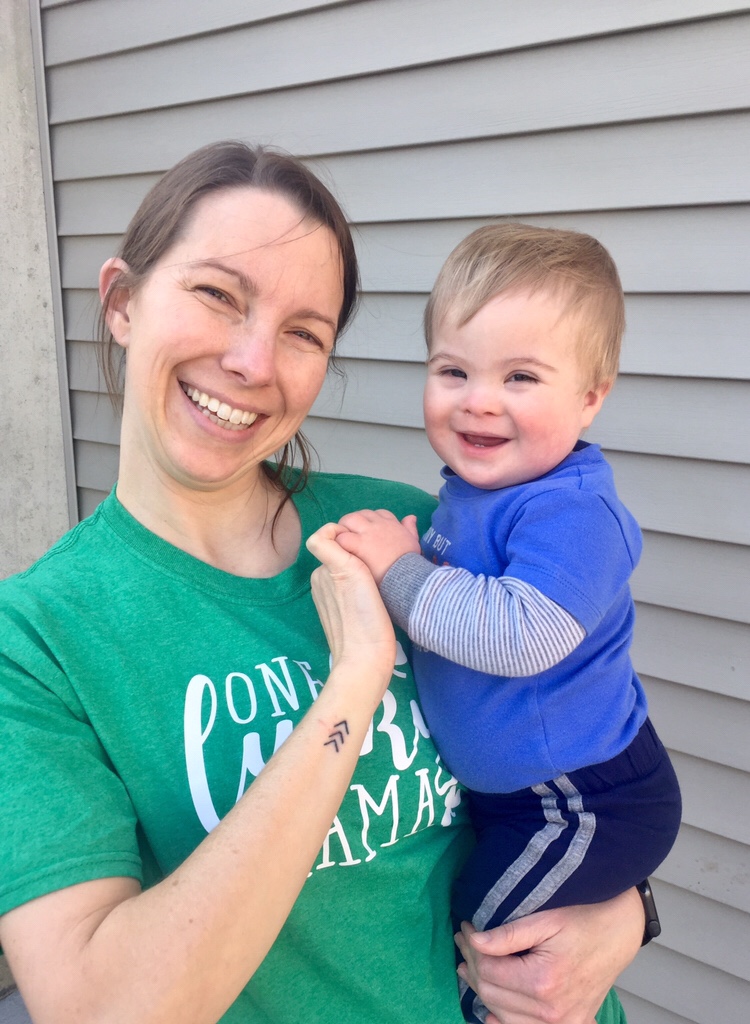
When we were dating, Tyson and I discussed our shared view on not having kids. We were both older (like real old…I was 29, he was 33) and very set in our independent ways. Kids did not fit in the vision we had for our future together of basically continuing doing whatever we wanted, whenever we wanted.

Fast-forward 7 years and 2 kids later. This man was meant to be a dad. I know there are things that he misses about being kid-free, but when watching him with his children it’s easy to see he was made to be a dad.

Being a dad to a strong-willed, independent, opinionated little girl is not for the faint of heart. Tyson was made to be Josie’s Daddy. He is firm when he needs to be and the biggest pushover the rest of the time. When it comes to putting the kids to bed, Tyson is the parent that actually enforces a consistent, appropriate bedtime. However, as soon as that little girl comes walking down the hallway wanting to cuddle with Daddy and watch the football or basketball game with him, the word “No” is missing from his vocabulary.

Then there’s Moses. If there was ever a man designed to be a dad to a child with special needs, it was Tyson. Not because he works him overtime in his therapy or because he dismisses the fact that he has Down syndrome. It’s because Tyson looks at Moses and sees his son for who he is and just simply loves him. He expects out of Moses what he knows he can do and pushes him just the right amount. Tyson makes him do the correct signs for “eat” and “drink” and “thank you” during meals before he gives him something to eat or drink. Me? All Moses has to do is look at me, smile; and sign “more” and I’ll give him as many crackers as his little heart and belly desires. You don’t want to sign “all done”? Not a problem, baby boy!

It wasn’t on my mind at the time, but when I married Tyson, I married the perfect father for our children. He’s going to shape Josie into a well-rounded, respectful young woman and teach her what it looks like for a man to love and respect his partner in life. He’s going to do whatever it is that Moses will need to reach his full potential and be there for him every step of the way.

As for me, he’s going to fill my days with joy and happiness as I watch him be the best Daddy to our children that he can be.

He’s All Mine

I knew I was going to marry Tyson Moyers within a month of meeting him. From the get-go, it was just different with him, and by different I mean it was right. With Tyson there were no games, no wait-three-days-before-calling-her, no sleepless nights wondering what I did for him to just stop texting me. He liked me and he let me know it.

Because this was waaayyy different from what I had experienced in the decade before I met him, I was a little hesitant at first to trust that what I was seeing in him was real. It didn’t take me long to learn that Tyson Moyers was genuinely a good man. With him I could be myself without worrying if I was funny enough or smart enough or pretty enough or intriguing enough. He made me feel like I was simply enough by just being me. I had finally found my Prince Charming, and I was going to marry him.

Being married was the one thing I had wanted most after college. To me, marriage meant security and stability, two things that I craved after the roller coaster of my college years. Don’t get me wrong, I had a blast in college. I loved being out of the fishbowl of my hometown, meeting new people, and just being responsible for taking care of myself. However, the lifestyle I was leading was very superficial and after a while I wanted something that was real and meaningful. In my mind, I was going to find that in marriage.

Dating Tyson was fun and exciting yet comfortable and secure. It was what I wanted for the rest of my life. When the weekend of our one-year anniversary rolled around, Tyson told me he was going to take me to dinner at a nice restaurant and then we were going to go back to the place where we were introduced. I was ecstatic. I was 99% confident that he had figured out he should marry me and that the proposal was going to happen on this romantic date he had planned.

It didn’t. I was pissed. I went to church the next morning and asked God to give me more patience since Tyson clearly wasn’t on my time schedule. I went back to his house to get ready to go to the lake and proceeded to pout and give so much attitude that he suggested I not go. Although that was tempting because I didn’t like him at all at the moment, I went to bathroom, had a good cry, then went outside and got in the Jeep. I started talking to him again about halfway to the lake, and by the time we got there I had talked myself into being okay with having to wait a little longer to get engaged.

About an hour later, he proposed to me out on the lake at the spot where we had our first kiss. I know I should’ve felt more remorse for my poor behavior that morning, but I was too busy being the happiest woman in the world.

I had finally found my match. The person that would both accept me and challenge me. The person that would be my rock in my hard times. The person that would encourage me and support me when facing life’s changes and challenges. The person who would put my happiness at the top of his list of priorities. I had finally found the person who would be for me what I would also strive to be for him.

Today marks our 7th anniversary. Has being married been all that I thought it would be? Yes and no. No, I didn’t think it would take as much work as it does to keep it on track. But yes, it has given me that sense of security and stability. Yes, life with him is real and it is meaningful. Yes, I still feel like I’m enough for him. Yes, through all the ups and downs we’ve encountered, Tyson remains my rock, my encourager, my supporter, my challenger, and best of all, my husband. And he’s all mine.

“Because He’s My Best Friend”

https://www.cbsnews.com/news/rachel-newberry-ben-robinson-promposal-burnsville-north-carolina/

This. Over the years of being on social media, I’ve seen videos and stories of “typical” kids asking peers with special needs to events like prom. This one seems a little different, though, because the reason the young lady asked her friend to prom is simply because he’s her best friend.

One of my many prayers for my children is that they are loved for who they are, not just a piece of who they are. I also pray that they look beneath the surface with others, too.

Stigmas, Stereotypes, and Tattoos

A few months ago, I came across an article titled “Parents of Kids with Down Syndrome Are Getting This Tattoo“. The article told the tale of a group of 20 moms that had children with Down syndrome spending a weekend together bonding over their shared experiences and ultimately deciding to get a tattoo of three arrows to symbolize the three copies of the 21st chromosome and how like arrows, “…we rise up and move forward…we fly the highest after we have been pulled back and stretched, sometimes more than we think we can bear.” Those 20 women have since inspired hundreds of parents and family members to get the tattoo in support of Down syndrome and one another.

Within a couple of weeks, I had received multiple texts and messages sharing the article with me. Yes, I had already considered getting the tattoo after reading the article the first time but knowing that tattoos are permanent and still carry stigmas and stereotypes in the eyes of some, I didn’t know if it was really a bandwagon I wanted to jump on. Then I was tagged in a post on the Facebook by another mom asking if I was in. I could blame my public answer of “Yes!” on the couple glasses of wine I had enjoyed that afternoon, but the fact is, I knew I really wanted that tattoo.

The term “advocate” really didn’t enter my vocabulary until I was getting my Masters to be a school counselor. That’s when I learned that part of my role was to advocate for myself and the school counseling program because there is still some confusion and misunderstanding about what a school counselor is and should be (hint: a school counselor is not an administrator nor a secretary/administrative assistant…but that’s another post).

When I learned I would be most likely be having a baby with Down syndrome, that word started popping up again but I really didn’t see myself as needing to be a very vocal advocate for Down syndrome because hadn’t so many people long before me already done a great job of it? I mean, my mom told me that when she was growing up, kids with Down syndrome were shipped off to institutions because it was believed that there was no need for them to go to school. From my experience working in a public elementary school, I knew that was definitely no longer the case. Mongoloid is no longer a term used for a person with Down syndrome, and I don’t hear the “R-word” like I did when I was younger. Nope, all I was going to need to concern myself with was loving and taking care of my baby the best I could no matter if he or she had Down syndrome or not.

HAHAHA!!!! The joke is most definitely on me! Not only have I advocated for Moses since the day he was born, but I’ve also learned how important advocacy still is in the Down syndrome world. Just like there are negative stigmas and stereotypes that surround people with tattoos, there are still negative stigmas and stereotypes that surround people with Down syndrome. While there has been a tremendous amount of work that taken place to get society to view individuals with Down syndrome as people whose lives are worthwhile (because they are), there is still a sense of sadness, anger and fear that ripples through parents of children with Down syndrome when we are reminded that  there are people like Ruth Marcus who would publish a column just five days before World Down Syndrome Day in support of aborting babies with Down syndrome. And that there are countries allegedly trying to eliminate Down syndrome from their entire population. When there are doctors and genetic counselors in our own country that paint a picture of despair upon delivering the news that prenatal screening indicates Down syndrome and gently remind the expectant mother that there are “options”.

So yes, I got the tattoo. I love it. I am proud of it. I am proud to get to explain it to others what it means. I’m excited at the thought of one day seeing it on someone else that I have never met in my life and know that we’ll be able to proudly smile at each other knowing we’re in the same club. I am proud to know that I am doing everything I can to further remove the negative stigmas and stereotypes that surround Down syndrome. And who knows? Maybe I’ll even be and unknowing advocate for the tattoos, too.