Ask All the Questions

“Does Moses have a brain?”

That was the question one of his classmates asked last fall during a lesson about the brain in the Counseling class I was teaching. They were learning about different parts of the brain and the jobs they do, focusing on the thinking, feeling, and doing parts of the brain.

Standing in front of the class, I could tell that many of the other students were surprised she had actually asked that question. Because not only was I the school counselor teaching the lesson, I was also Moses’ mom. I could tell that many of them were thinking, “Is she going to get mad/upset?”

I looked at her and gave her a little smile and said, “Yes. Moses had a brain. He’s a human and all humans have brains. I think you’re noticing that his brain works differently because he doesn’t talk and do some of the same things in the same way you do.”

Did it sting a little when she asked that question? Of course. But more than that, I felt grateful that she was trying to understand what was going on with this boy in her class who was clearly different from most of the other students. I was grateful for the authentic curiosity and willingness to try to understand as I did my best to explain that having Down syndrome caused the parts and connections in his brain to work a little differently. I told the class that it was kind of like the parts of his brain were trying to talk to each other, but they had a hard time hearing each other. So they had to repeat themselves and practice things more to make sure they were getting it right.

A couple of months after that question, I heard another one. This time from his younger cousin. I overheard her asking “Why doesn’t Moses talk?” Unfortunately, I was in another room and was busy with something so I wasn’t the one she was asking and I didn’t get to answer. I would have loved to tell her that his words don’t come out clearly because his brain works differently. But he “talks” in other ways, like how he taps her shoulder to get her attention and uses gestures with his hands to help her know what he’s trying to tell her or wants her to do. Or how he joins in on games and laughs along with his cousins as they play without needing to say a word. Or how he holds out his arms for a hug.

I love it when people ask questions about Moses. Especially kids. Questions reflect a desire to know him. To understand him. It’s not a bad thing to notice that he’s different or that things are different for him. That comes with him having an extra chromosome. Ignoring that fact or brushing it off can actually be a much more hurtful thing. Since having Moses, I have adopted the mindset that questions lead to knowledge, knowledge leads to understanding, understanding leads to acceptance, and acceptance leads to inclusion.

That’s what we want for Moses. For him to be accepted and included for who he is. If asking questions about him is going to lead to that, then ask all the questions!

Which leads me to two of my favorite questions that I’ve been asked in the last year:

“Where is Moses?”

“Can Moses come play?”

What questions do you have?

A New Norm

Today we had Moses’ annual IEP meeting. That in and of itself was not too remarkable. What was remarkable to me was that I forgot about it. Last night when Tyson said something about it, I had no idea. I knew it was coming up this month, but I thought it was maybe next week. 🤷‍♀️

In the past few years, I knew exactly when his IEP meetings were because I was a ball of anxiety the week leading up to it. There were so many questions and uncertainties that I would be texting people the night before and day of asking for prayers. I would barely be able to sleep the night before. 

Last night, his meeting wasn’t what was on my mind as I drifted off to sleep. 

Before his Kindergarten IEP transition meeting, I was a ball of anxiety. I was so worried about what Kindergarten was going to be like for him, and if he was going to be given the chance to show how much he was capable of learning and doing. I can remember the woman who was going to be his Kindergarten teacher came to me and said, “I need you to trust me.” 

Back then, it wasn’t necessarily that I didn’t trust her. It was that I didn’t trust the system. From my own experience of working in an elementary school, the norm was definitely not for a kid with Down syndrome to be included in the general education classroom almost all day. It was exactly the opposite. It was hard for me to trust that it could and actually would be different for my kid. 

But it was. And it has been again next year. 

Now, I fully trust Moses’ IEP team to work together and work with Tyson and me to make sure that Moses is included as an important part of his classroom. He is held to high standards academically and behaviorally, and he is absolutely thriving. He’s honestly doing things that I didn’t expect him to be doing in 1st grade. But then again…he always manages to show me he can do ANYTHING! 

At the end of the meeting today, I did what I always do at the end of meetings about Moses….I cried. I cried tears of gratitude for the amazing people who work so hard every day to make school a place where he can pave the path for a new norm for himself and hopefully other kids with Down syndrome. 

Anxiety vs. Anticipation

This morning as I sat on the edge of the exam bed and watched the images of Moses’ heart show up on the screen, I noticed a familiar feeling coming up in my chest and head. I thought to myself, “I’m starting to feel anxious.”

Six years ago, Moses had a device implanted to close the hole in his heart. He has an echo and ECG done every 3 years to make sure everything still looks good.

Going into this appointment, there was really no reason to think that there was anything to be concerned about. Moses is healthy and shows no signs of any issue with his heart. Still, sitting on the edge of that bed and seeing the images triggered that pesky doubt that is always there, waiting for its chance to take charge.

All too often I let it do just that, especially when it comes to Moses and his health.

But today, I paused and changed my wording. I took a deep breath and thought, “I’m starting to feel anticipation.”

Anticipation can go both ways.

That helped me to refrain from going down the rabbit hole of anxiety and imagining what possible problems and challenges we might be facing.

Instead I was able to continue watching and telling Moses what an amazing job he was doing and genuinely stay calm.

When the doctor came in before the tech had even finished the ECG and reported that the echo looked great and the ECG did, too, the joy came.

Yes, Moses has had health challenges. And some of them have been serious.

And through every one of them, God has been there. He has always brought him through it.

So it was with anticipation of God’s continued presence and goodness that I was able to stay calm today. That I was even able to feel hopeful that things were going to be okay.

Sometimes just a small change can make a big difference. Sometimes all it takes is changing one word.

Right Now, It’s Just Hard

For some reason I thought that parenting Moses would get easier as he got older. I thought that we would get things figured out in the early years and then just roll right along without so many bumps in the road.

I was wrong.

Here we are 7 years in, and I feel like the last year has been the hardest of them all.

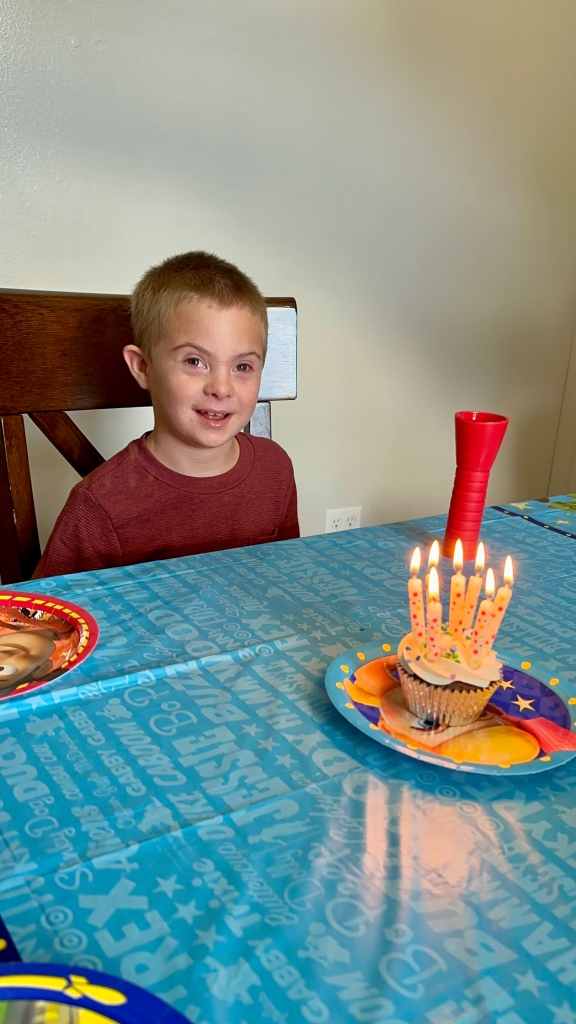
Celebrating Moses’ 7tb birthday

Navigating preschool was easy. Navigating elementary school is hard, and that’s with have an amazing IEP team at his school. I hate to think what it’s like for parents who don’t have the support that we do. And this is only his second year. I felt like getting 1st grade started was harder than the whole of Kindergarten, so I’m already apprehensive about the coming years. 

He’s still not talking super clearly. His speech is improving for sure, but there’s still so many times that I have to ask him to “say it again” or just nod and say “okay”. And then I feel horrible when he’s clearly frustrated that I didn’t understand him.

He’s had some weird medical things going on. Thankfully none of it has been serious, but having to make multiple trips to doctors has added another challenge to deal with.

At the end of the summer, I broke down when my husband asked me about what trip we might do next and told him that I would rather just stay home. Between having to watch him constantly because he will wander off in the blink of an eye and making sure that he’s getting to do things he enjoys and trying to figure out what exactly that is, I was mentally and emotionally exhausted even thinking about taking him to the local park let alone on a trip somewhere. 

By the time school started back this August, I was crying tears of relief and guilt. Relief that I was getting to go back to work and getting a break from being a full time mom, and guilt from feeling like I needed a break from being his full time mom.

For the first time I found myself asking God, “Why me? Why did you think I was the best person to be his mom?”

One day this summer, another mom told me that it gets easier. I know it was meant to comfort me, but it didn’t. It still doesn’t. I don’t know that being Moses’ mom will ever be easy. Maybe it would be easier if I accepted “good enough” or “that’s just the way things are”. But good enough isn’t always good enough. The way things are isn’t always what’s best for him. And God didn’t make me to be one to sit by and not say anything. 

So I’ll get up tomorrow morning and do my best for him again. I’ll keep advocating for him and speaking up for him and working to change what needs to be changed for him and for others with developmental disabilities. And then I’ll do it again the day after that and every day of my life. Because that’s what he deserves.

Maybe that’s why God chose me. Because he knows that I love him with every ounce of my being. And he knows that I will always fight for my son. For both of my kids.

I know that I’m not on this journey alone. Sometimes I feel like I am, so I have to remind myself that God did not put me on this path to walk it alone. I’m grateful to have my husband walking beside me through these challenging times. I’m grateful for the people who listen and try to understand what I’m going through. I’m grateful for their encouragement and support. I’m grateful for the people who are willing to make changes where they are needed.

Maybe it will get easier at some point when he’s older. Right now, it’s just hard.

I’ve hesitated to share this because I’m not looking for pity or a pat on the back. I almost didn’t share it for that reason. But then I remembered why I started writing and sharing about the ups and downs of my life in the first place…to help others know that they’re not alone. I know I’m not the only person who is going through a hard season. I’m not the only person who is struggling to find joy in the journey or keeping faith that this is part of God’s plan and His plan is always good. As always, I hope that by sharing my story, I might be able to help someone else. 

Choose Your Focus

On the way home from school today, Josie suddenly asked me, “Would it be hard if I had a disability, too?”

Since I was completely caught off-guard, I asked her, “What do you mean?”

She answered me, “Would it be hard if I had a disability like Moses?”

I thought for a few seconds and gave her my honest answer: “No, I don’t think it would be hard. We would do whatever it was that you needed to live your best life. And we would love you just like we love you right now.”

At that point, we had pulled into the garage. She got out and went inside. By the time I got Moses out of his car seat, gathered all of my stuff, and got inside, the conversation was clearly over. She had already unpacked her backpack, gotten herself a snack, and turned on the TV.

To be honest, I didn’t think anything else about the conversation, either, as I started putting my things away, unloading the dishwasher, and mentally preparing myself to clean the shower in my bathroom. (I would rather dust all day long than clean that shower.)

A few hours later, Josie was across the street playing with her friend, and Moses and I took Opal for a walk. Not long into the walk, he reached over and grabbed my hand. Every few steps he would stop, squat down, count to three, and then he would jump up and I would pull a little to help him go even higher. He loves this game and the laughs we both get out of it are the best.

After a while, he stopped jumping and we just walked hand-in-hand. At one point, I looked down at him and he looked up at me and smiled. It was one of those smiles that shines of pure happiness and love. One of those smiles that catches your breath and your heart.

That’s when I thought back to the question Josie had asked me earlier. And I thought to myself, “This isn’t hard.”

Yes, having a child with a disability comes with challenges. And if I focused on the challenges and dwelled on them day-after-day, then I would surely say it’s hard to have a child with a disability.

However, when I watch my son laugh and play and enjoy this life he’s been given, I find it difficult to see the hard. If he’s not dwelling on the challenges he has, then why should I? What good would that do him? What good would that do me?

There are times to focus on the challenges. When they are having a negative impact on him, they need to be addressed. There are some instances when it is in his best interest to be proactive and attempt to address potential challenges before they arise.

I do the same thing for my child who doesn’t have a disability.

But that’s not where I choose to keep my focus.

Ever since I found out my child was going to have Down syndrome, it has been important for me to remember that I have a choice about how I look at things and what I focus on. And I choose to look at my son and see the strength and determination and joy and love that he has. I choose to look for the solutions to the challenges he faces and focus on implementing them. I choose to advocate for what will help live his best life rather than accept certain things as-is.

There are times that it would be easier to focus on the challenges. To focus on the hard. But if he’s not choosing to do that, then why should I? Why should anyone?

I would much rather focus on that smile that catches my heart.

What do you choose to focus on?

When Will Progress Be Enough?

When it comes to people with disabilities, there has been a lot of progress in this country over the past 100 years. For example, people with disabilities are no longer forced to be sterilized, doctors do not recommend that babies born with disabilities such as Down syndrome and cerebral palsy be institutionalized instead of raised at home with their families, employers cannot discriminate against hiring people with disabilities, schools are required to provide a free and appropriate education to all children, and there are many supports available to people with disabilities and their families. 

While this progress is great, it is not enough.

For the past 8 months, I have had the honor of participating in a program called Partners in Policymaking which is hosted by the Missouri Developmental Disabilities Council. Each month, I have participated in Zoom meetings listening to speakers and advocates from across the country share information and experiences about the issues that impact people with disabilities. 

Through this experience, I have learned that people with disabilities in our country still face many obstacles and discrimination and families are still having to navigate systems that are, in many ways, stacked against them.

I have learned that in education, special education has become a place instead of a service. In doing so, it has created segregation in schools that does a grave disservice to all students. Students with disabilities are taught to succeed in a segregated environment and are denied being a part of the “real world” the education system is supposed to be preparing them for. Students without disabilities are taught that students with disabilities are different and cannot do the same things they can and it’s really important to be nice to them. 

I have learned that sheltered workshops serve to keep people with disabilities segregated from the general public by giving them jobs that are carried out in isolation or with a group of people with disabilities(i.e. sheltered workshops). There are given “jobs” such as taking bolts off screws and then putting them on again. They are paid subminimum wages to “protect” their ability to qualify for Social Security and Medicaid benefits instead of paying them a fair, living wage that would allow them to pay for the things they need to live a healthy, successful life. 

I have learned that people with disabilities are stripped of their rights when they turn 18 and are put under guardianship of an adult. The guardianship that is designed to “protect” them strips them of making decisions about where they live, what they can spend their money on, who they can spend time with, if and where they can work, if they can have a romantic relationship, etc. etc. As one speaker told us, prisoners on death row have more rights than a person with a disability under a guardianship. 

I have learned that there are people in leadership positions (i.e. government, healthcare, education, etc.) making decisions that directly impact the lives of people with disabilities who have little or no personal knowledge or experience of living with a disability. Many times the decisions that are made may sound good in theory but ultimately are not in the best interest of people with disabilities.

I have learned that it’s really not that difficult to have a child with a disability. It’s very easy to love him and meet his needs because he is my son and that’s what a parent does. 

I have learned that it is not up to anyone other than the person with a disability himself to decide what he can or cannot do; can or cannot learn; can or cannot achieve. It is up to the people in their lives to ensure that they are able to live the life they want.  

I have learned it is the policies and practices in place that make it difficult to have a child with a disability. 

I have also learned that there are solutions to all of the issues and challenges people with disabilities and their families face. 

In the area of education, there are multiple studies that highlight the benefits of fully inclusive classrooms, one of which is higher academic scores for ALL students – both those with and without disabilities. (Interestingly enough, there are no studies that say otherwise.) An inclusive classroom is one in which all students feel a sense of belonging and purpose; all students are integral in building the community in the classroom; no one is expected to change in order to belong. The community is built around the idea of finding commonalities so that everyone can learn from each other. As far as academic content, it is taught with modifications and accommodations in place to support the success of all students, such as having a co-taught class with a general education and special education teacher. Another benefit of inclusive educational settings is that all students are also being prepared to be successful in the real world. 

I have learned that when people with disabilities are taught and given the appropriate supports, they can be successfully employed and earn a living for themselves. There are services such as  vocational rehabilitation that will work with a person with a disability to help him identify the job he wants and then ensure that he has access to the things he needs to be successful in that job. For some people that might be that they are taught certain skills they will need on the job. For others it is helping to fund the education needed to be able to obtain the job they want. They will work with employers to determine how to best help the person with a disability to be successful. People with disabilities deserve to have real jobs, make real wages, and work within real businesses. 

I have learned that supported decision-making is a much more appropriate approach to supporting individuals with disabilities as they enter into adulthood. Instead of placing them under a guardianship, which removes some if not all of their personal rights, developing a supported decision-making team and plan ensures the person with a disability has as much autonomy as possible over her life. Supported decision-making involves the person with a disability at the center, asking her questions such as: What are your goals? What do you need in order to reach those goals? Who can help you if you need it?  Decisions about the person with a disability are made with her instead of simply for her. 

I have learned that people in leadership positions do not necessarily intentionally make decisions that adversely impact people with disabilities. Many times it is simply because they have no personal experience with disabilities and don’t have the information needed to make more informed decisions. Ideally, they would be actively seeking out that information themselves. However, in reality, I have learned that it is usually up to advocates – individuals with disabilities, parents or family members of people with disabilities, people who have personal and/or factual knowledge what it is like to have a disability – to speak up. To request meetings. To present data. To bring the information necessary to those making decisions so that decisions and policies can be made that are truly in the best interest of ALL people.

I learned these things from specialists in these different fields – parents, teachers, government officials, policy makers, and most importantly, self-advocates. One of the most impactful speakers I had the honor of learning from during this course was a self-advocate named Ken Capone who was born with cerebral palsy. His parents were recommended by his doctor to put him in an institution because of his disability. Thankfully, they did not listen to him and raised their son with the rest of their children. They advocated for him to attend school in the general classroom and he graduated from high school with the rest of his class. He now lives independently and has a full-time job. He has a bill named after him, The Ken Capone Equal Employment Act, which makes it illegal in the state of Maryland to pay people with disabilities sub-minimum wage. I learned all of this by listening to him as he used a head stick to type on an iPad and then had it speak his words aloud. And he was able to do that because his parents focused on his abilities. Because he was fully included in the educational system. Because he was supported in finding a job he wanted and enjoyed. Because he had people in his life that advocated for him and supported him in his dreams and goals.

Again, a lot of progress has been made in the past century regarding people with disabilities in our country. I look forward to seeing more changes being made in education, employment, and other policies so that one day people with disabilities do have equal rights, opportunities, and access in our country. Only then will it be enough.

If you’re wondering what you can do to help ensure that the needed progress occurs, first of all, you have to believe that people with disabilities are valuable and deserve equal rights, opportunities, and access. Next, learn more. Ask questions and be open to answers that challenge your existing views and beliefs. Finally, be willing to speak up in support of people with disabilities.

I hope to see “enough” reached for my son and all those with disabilities sooner rather than later.

The Perfect Tea Party

This evening after the kids and I had gotten home for the day, Josie went across the street to play with a friend, Moses went downstairs to the basement, and I started putting away dirty dishes and mentally figuring out what needed to get done this evening.

I heard Moses coming up the stairs carrying something that was banging around. When he got to the top and walked past where I was standing in the kitchen, I noticed it was the little case that holds Josie’s tea set. Usually he’ll just bring up one or two cups and the teapot, and he’ll fill up the teapot with water and then pour it into the cups.

He’s been doing this for a couple of months, and his process is pretty cute: He walks around to the back of the sink to turn on the water because he can reach the handle from there without a step. Then he goes back around to the front of the sink where he has a step set up and he fills up the teapot. Then he walks around again to the back of the sink to turn the water off. (Yes, I realize he’s wasting water, and for these purposes, I’m totally okay with that.)

So I really didn’t think much of him bringing up the entire case, nor when I heard the water being turned on and off. At this point I had gone into my bedroom to change clothes and sit on my bed to scroll through Instagram for a minute (or 5).

The next thing I knew, Moses came into the room saying, “It’s ready!” He walked over, grabbed my hand, and led me out of the room. I asked him, “What’s ready? The water?” He nodded and said, “Uh huh.” He took me into the dining room where I saw that he had not just poured water for the two of us, he had put a cup at each chair and had poured water in all of them.

Our real-life dining room table. Almost always full of clutter and never Insta-ready, and tonight perfectly set with eight teacups full of water.

He was so proud of himself as he pulled out a chair and patted it for me to sit down. He was so annoyed with me as I took a picture to capture this sweet result of his thoughtful brain.

I took a drink of the delicious water he had poured, and then he took the cup from me and finished the rest.

Then he walked away, satisfied with his work and that I had enjoyed it, and came back with his Kindle to let me know he was done with me.

I thought my heart would burst thinking about the thought he put into this endeavor.

And I couldn’t help but to think about the doctors who told parents to send their babies with Down syndrome to institutions where they would be kept “comfortable” as they would never be able to live a quality life according to their standards. Or the parents that listened and missed out on knowing the beautiful human that was gifted to them.

I can’t help but to think of the doctors even today that find no value in a baby with the wrong number of chromosomes. Or the parents who take the advice of those doctors, and even friends and family members, and abort a baby that could have Down syndrome and hope for a “normal” baby next time.

My heart hurts for those perfect babies and children that never got a chance to show exactly how amazing they were and just what they really were capable of doing. Who never got a chance to let their light shine. I hate it for the parents who missed out on the perfect tea party because of misconceptions and stereotypes that still plague people with Down syndrome.

As I walked around the table wiping up the spilled water around the cups so thoughtfully placed at each seat, I couldn’t wipe the smile off my face because here is a little boy that not too long ago would’ve been assumed to be able to do little more that breathe on his own, planning and setting up a tea party anyone would be lucky to get to join.

The Magic of Acceptance and Inclusion

A few weeks ago, my parents gave my brother, sister, me, and our families the gift of a Disney cruise to Alaska. There were so many amazing things about the entire trip – especially getting to have our entire family together for a week. However, there was one experience that stood out for me and I will never forget it.

On the third day of the cruise, the ship docked in Skagway, Alaska. We spent the morning driving up into the mountains and enjoying seeing the beauty of the mountains, lakes, and waterfalls that surrounded us. And by we I mean Tyson and me. Josie and Moses were bored to tears.

That afternoon, Tyson and Josie went ziplining so I took Moses back to the ship. We went up to the pool deck where there was a place for him to get some chicken strips and for me to get an adult beverage.

While we were sitting at our table, one of the ship’s lifeguards walked by. He saw Moses and said, “Hey buddy! How are you?”

After a morning of sitting in a vehicle bored out of his mind, Moses wasn’t in the best of moods, so he responded with a very firm, “No.”

Undeterred, the lifeguard continued to try to talk to Moses and get him to engage with him. Also undeterred, Moses refused his efforts.

The lifeguard said, “What’s your name?” (Side note – That he asked Moses directly what his name was instead of asking me earned this guy a gold star in my book. He did not assume that Moses couldn’t or wouldn’t answer him. It was awesome.)

When Moses didn’t answer him, I said, “This is Moses. He’s had a long morning and is obviously pretty cranky.”

The lifeguard laughed and said, “Give me 10 minutes and I’ll win him over.”

Well, it had already been at least 3 minutes, so I figured if this guy wanted to be rejected for another 7, that was his choice.

He gave it a good effort for a few more minutes and then said, “Okay. I’ll leave you alone now, Moses.”

As he started to walk away, I said, “Moses, do you want to tell him ‘bye’?” At that, Moses turned and gave the lifeguard a big wave and “Bye!”

A smile lit up the lifeguard’s face and he said, “Yes! I knew I could do it!” He came back over and asked for a high-five and a fist bump, both of which Moses gladly gave him.

Four days later, we were at sea on our way back to Vancouver. Josie had been waiting all week to go down the big waterslide on the ship, so she got her swimsuit on and went up the stairs to the top of the ship and where the waterslide started. There was a monitor on the deck where we could see when it was her turn so we could be ready to watch her as she came down the slide. Tyson and Moses missed her first run, but they were there for the second. When we saw that she was next, Tyson took Moses over to where he could watch her come down.

When she did, we all clapped and cheered for her. The lifeguard on duty turned and said, “Moses! Hey buddy! Do you want to do it?”

I’ll be honest, I had totally forgotten about the lifeguard and his encounter with Moses 4 days before. But he hadn’t. He even remembered his name.

Moses answered with a big nod of his head and a clear “Yes!”

Tyson and I looked at each other. Moses loves to slide. And he’s gone down some pretty big ones. But none as big and as long as this one and a waterslide at that.

I asked Moses, “You want to go down the waterslide?”

He again said, “Yes!”

Tyson looked at the lifeguard and asked, “Can he go down it? Is he old enough?”

The lifeguard said, “Sure he can go down it! It doesn’t matter the age. He just has to be 36″ tall, which he is, so he can do it.”

So I ran down to our room, grabbed Moses’ swimsuit, and made my way back up to the 9th deck as quickly as possible. Tyson got Moses changed into his swimsuit and then took him over to where the lifeguard was standing. He told him that he could walk up to the top with him or he could go with Josie, who was standing right there waiting. He said, “Either way, I’ll be right here when he comes down to help him if he needs it. He’ll be fine.”

With that, Josie took Moses’ hand and led the way up the stairs to the top of the slide. Tyson and I stood watching the monitor anxiously waiting to see the top of Moses’ head. A couple of minutes later, there he was, impatiently waiting his turn with Josie doing her best to keep him in line.

When it was finally his turn, he stepped over the lip of the slide entrance, sat down, and pushed himself forward. No hesitation. No fear.

When he came sliding down into view, he was backwards and on his belly. He hit the water at the end, sat up, and was met with cheers from my parents, my sister, Tyson, me, and the lifeguard. Just as he promised, the lifeguard was right there waiting for Moses. He clapped for Moses, gave him two big thumbs up, and high-fived him as he walked to the end. As Moses got out, the first thing he did was say, “Again!”

Sliding down to his own personal cheering section.
Hi-five from the most amazing lifeguard ever.

I lost count of how many times Moses went down the waterslide that afternoon.

If it hadn’t been for that lifeguard, I don’t know that Moses would have gone down that waterslide. It wouldn’t have been because he didn’t want to or because he couldn’t. It would’ve been because Tyson and I would have been too nervous to let him do it. That waterslide was really big and there wasn’t the option of one of us going down with him.

Some people may be thinking, “That’s the magic of Disney.”

I disagree.

This moment was brought to us by the magic of an individual practicing acceptance and inclusion. The magic of looking past stereotypes and focusing on abilities instead of limitations. The magic of seeing a person for who he is rather than his diagnosis.

There is no doubt in my mind that God made sure that our paths crossed with that lifeguard. He knew that some of us, including myself, needed the reminder that it’s not up to us to decide what Moses is or is not capable of. Moses can do that just fine on his own.

Us or Them

I wonder if other parents of kids with developmental disabilities ever feel the way I felt tonight. 

Moses’ IEP meeting is coming up to determine his placement going into kindergarten. I’ve already advocated for him to be able to go to summer school (or at least give it a try), and I’ve been laying the groundwork for him to be in the general education classroom as much as possible for months now. There’s so much evidence in support of the benefits of inclusion in education – academically and socially for both kids with and without disabilities – that I feel like there’s no reason for him to ever not be in the general education classroom. 

And yet I know that the biggest barrier that we will face in achieving that is the mindset that because children with disabilities don’t always learn at the same pace and/or in the same way, then they should learn in a separate setting. It’s touted as being what’s best for them, although I haven’t been able to find any research to support that claim. 

Anyone who knows Moses knows that he has the ability to light up a room. He has a beautiful, playful personality and is the most determined little boy I have ever met. His brain is a sponge soaking up all the things that are going to help him lead his best, most successful life. He has so many gifts that he brings to this world and it seems like he’s wanted. For the most part.

Until it comes to education. Then it’s like he’s already been weighed and measured and has been found wanting based on his medical diagnosis and evaluation results. 

Nevermind that he has been absolutely thriving in his general education early childhood classroom. But yet now that he’s going into kindergarten, it’s being doubted that he can continue to do that. 

I think the hardest part for me is when I feel like he’s being doubted by people who know him and/or are in education and are supposed to support inclusion rather than integration or segregation. It’s hard when I feel like I have to advocate for inclusion with people who know Moses and how amazing he is, and yet I still find myself having to explain the value of him being in the general education classroom 100% of the time. 

Why do I have to explain that he can and wants to learn? Why do I have to explain that he can and wants to have friends? Why do I have to explain that he can and wants to be part of the classroom community? 

Why do I have to explain that as soon as he’s not allowed to be a part of the community that is built in the classroom within the 7 hours that they’re there from the first day of school until the last day of school, everything will change for him. He will at that moment go from being “one of us” to “one of them”. 

Tonight as I was laughing with Moses and just soaking up the joy he can exude, I suddenly had the thought, “Why do I want to share him with others so badly, especially when it comes to school? Why not just keep him all to myself?”

Part of me wants to say, “Fine. I’ll keep him to myself. I’ll teach him and explore with him and laugh with him. I’ll be the one to challenge him and encourage him and watch him experience success. I’ll be the one to help him realize how much he’s truly capable of in this life.”

But the other part of me knows that that is my exhaustion, frustration, and hurt talking. Advocating for inclusion is hard work and I’m learning that you don’t get to take breaks. Keeping him to myself might be easier, but it wouldn’t be fair to him or the people who would be missing out on getting to know him and to learn from him. 

Because the real kicker in all of this is that Moses has more to teach all of us than we could ever hope to teach him.

Which then begs the bigger question: Who would benefit more from inclusive classrooms? Us or them?

Stay Out of the Way

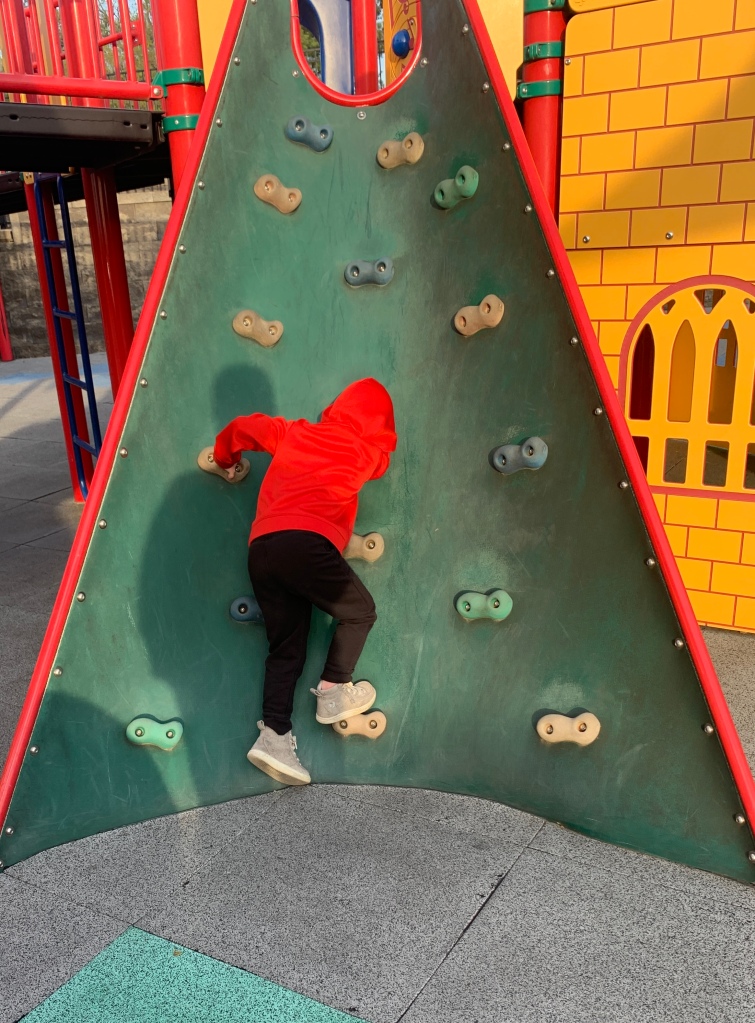
While we were at the playground this evening, Moses went over to a fairly tall, steep climbing wall. As he put his foot on the first step, I thought to myself, “I don’t think he can climb this.” Instead of going over to help him, though, I just stayed back out of the way and kept my mouth shut.

He went to step up on the second step, and then stopped and got off the wall. He ran back towards the slide he had been going down, but instead of stopping, he ran past it.

He ran to a shorter, less steep climbing wall on a different structure. And climbed right up it. It took him a little extra effort to pull himself up and over the top, but he did it.

So tonight’s parenting lesson brought to me by Moses was to stay out of the way. My job as his mom is not to decide what he is or is not able to do. My job is to give him the opportunity to try and support him in his efforts. If he needs help, he’ll ask for it. More often than not, however, he doesn’t need my help.

How many times do we as parents get in the way of our kids showing us, and themselves, what they can do because we decide for them whether or not they can do something? Or decide that they need help because they’re not doing it quickly or easily enough, or because it’s not the “right” (i.e. our) way?

Our kids are capable of amazing things. And they’ll be happy to show us if we’ll just stay out of their way.